

There’s a reason that the act of summiting a mountain has become a hackneyed metaphor for overcoming adversity: climbing a mountain is really, really hard. Extraordinary athletes brave the elements and pit themselves against gravity itself, sometimes at the cost of their own lives. Enter CAIRN, here to show you how little you’d want to try any of that in real life. The fictional Mount Kami has yet to be conquered; hundreds of climbers have either vanished or perished on its peaks over the years, and Aava, lifelong alpinist and minor celebrity, is the next challenger.
Never take life for granite
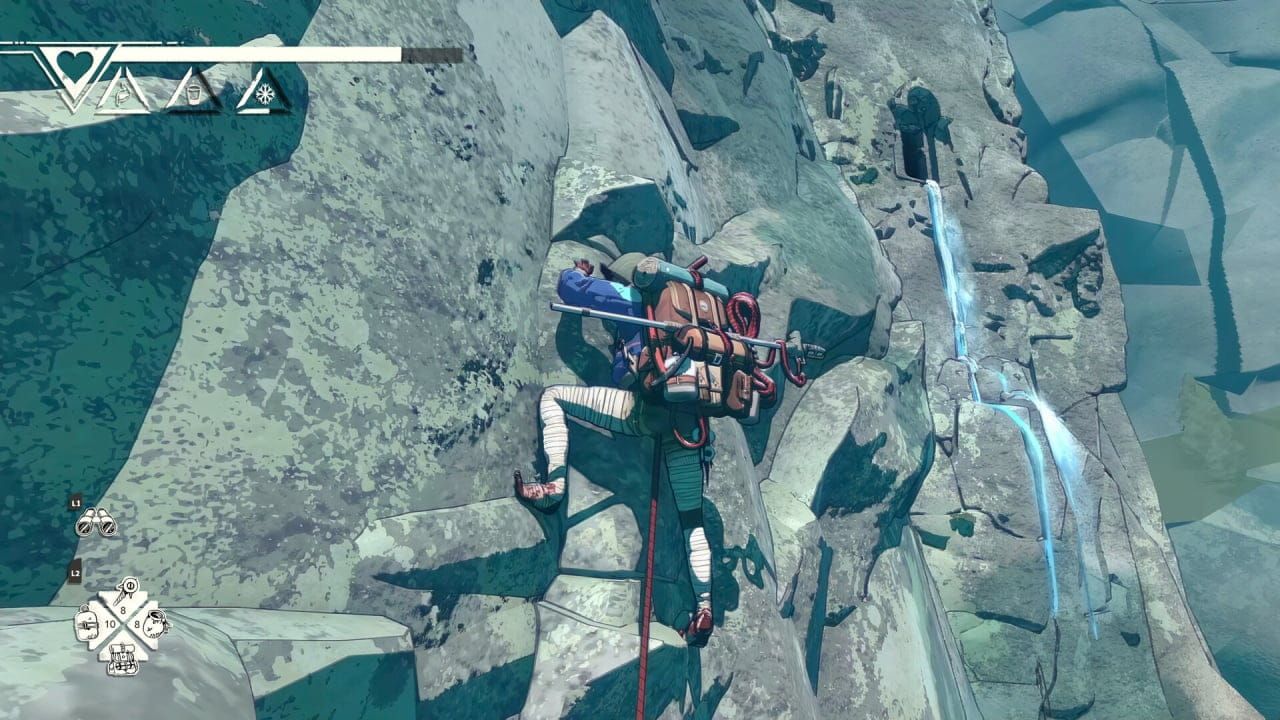
You begin your ascent in a high-altitude climbing gym. I can’t help but think that opening in media res directly on the rockface would have hit harder, though I understand the need to tutorial core systems in a safe environment. Various training walls border the gym, and it turns out Aava needs a little practice before she embarks upon her expedition. Control cycles through left and right limbs individually – the game selects the “best” option by default – and each must be placed strategically with the left analogue stick to provide enough leverage to reach for the next handhold.
Aava is astonishingly flexible and robust – a departure from other movement sims like Death Stranding or Baby Steps – which makes choosing your next hold a simple visual task: if you can reach it then you can hold it, but only for so long. Absent a stamina meter, you’ll rely on visual and auditory cues such as shaking limbs and heavy breathing; foreshadowing a nasty fall unless the player can maneuver into a more comfortable upright position. The recent addition of a manual mode in the months since our preview prevented much of the frustration I experienced waiting for the automated default to select my preferred appendage.
Aava carries a limited number of pitons (small metal spikes) that she can drill into the rockface to varying degrees of success. In gameplay, pitons basically operate as checkpoints that make higher-altitude errors far less frustrating and costly. The presence of the piton in both crafting and resource management, as well as the inclusion of a timing-based mini-game, makes the item additive to the game loop as opposed to the hollow checkpoint spam into which these systems so often devolve. Overall, climbing was gratifying in its intricacy without ever verging on full-blown simulator territory. Unfortunately, janky controls more often than not betrayed an otherwise well-designed movement system.
Even the best games are just guessing as to what action you want to perform; based on a combination of controller inputs and location in the environment. Think about how many times Ezio unintentionally launched himself from a Florentine rooftop in Assassin’s Creed. The Game Bakers have run into a similar issue here: finding the right handholds or footholds became rather finicky, often requiring multiple attempts until Aava’s hand properly gripped the rock, an issue exacerbated whenever you approached an overhang or precipice. Similarly, resuming my climb after drilling a piton would frequently place Aava in a stress position that blew through her stamina in a matter of moments, creating an exasperating loop of falling and scrambling and so on. Climbing should have been a puzzle; instead, it felt like a fight. Though I did find these issues progressively more frustrating, I cannot deny the pleasure (and relief) of watching Aava pull herself up onto a ledge, safe in the knowledge that I had made substantial progress on my journey up Mount Kami.
“All I ever wanted was to touch eternity for an instant”
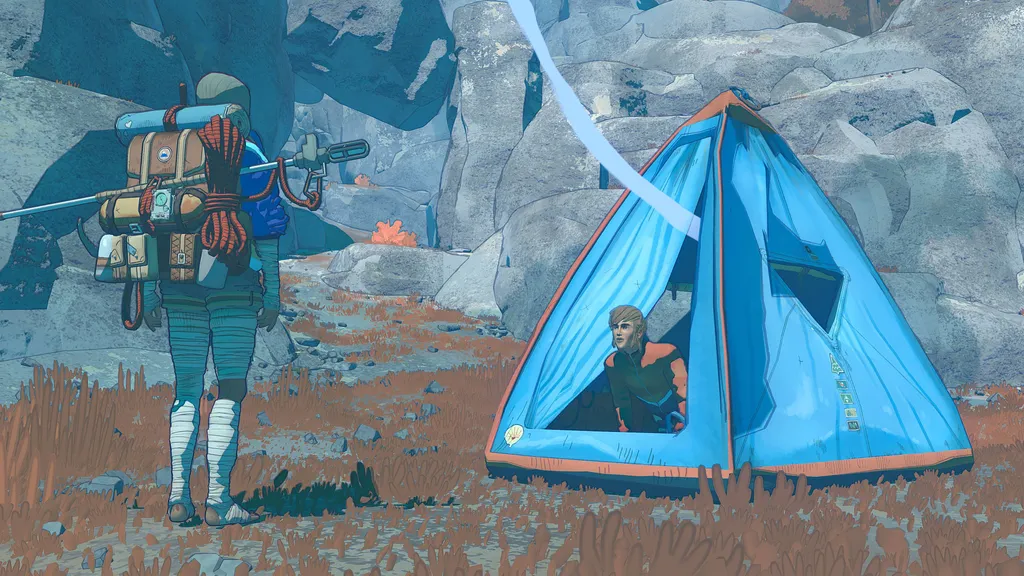
The opening hours of my expedition took me up a winding pathway, bordered by grass and flowers, punctuated by a few short climbs. The lightly cel-shaded art style – reminiscent of critically-acclaimed puzzler Blue Prince – paired wonderfully with the natural flora and striking vistas, and fortunately granted the otherwise sheer rockface a degree of legibility. The best thing about CAIRN might actually be its pacing, effectively striking the balance between long climbs and stunning interior environments, such as grizzly bear dens, beehives, and diamond mine shafts, where you’ll pick up resources and find materials left behind by the mountain’s native community, the Troglodytes. I surveyed classrooms, grave sites, goat farms and communal baths; all abandoned in the wake of tourism and urbanization. A vertical community broken by the allure of the horizontal world.
CAIRN also takes death seriously. Backpacks and tents are strewn across the mountain, and you’ll happen across a number of corpses swinging from the rockface. Memorably, a memorial for fallen climbers sat partway up an early climb. Of course, I might never have seen that memorial, or any of the landmarks I’ve mentioned so far, had I taken a different path. A handful of times I was presented two distinct routes, and I had to choose which way to climb. Those choices were final, believe me. I tried backtracking down to a cable car for more resources and instead ran out of rope, became trapped under an overhang, and promptly fell to my death. I sheepishly reloaded a previous save and kept on climbing. You may need another playthrough to see everything on offer, if you’re so inclined. Partaking in these smaller climbs often rewarded me with special gear such as indestructible pitons or glow-in-the-dark gloves, ensuring that taking a detour always felt worthwhile.
Aava isn’t entirely alone on her expedition. She’s accompanied by a personal climbot, an arachnoid assistant in charge of belaying and piton recovery, that also receives and plays radio messages from Aava’s partner, Naomi, and agent, Chris. Early communications make it clear that Aava is ignoring the both of them, even as Naomi spirals in real-time. CAIRN is all about isolation. A character study of someone so desperate to isolate themselves that they throw themselves onto the highest point of the planet. What is that person like? How do they treat others? And why do they want to escape the rest of the world? I found the answers to these questions unexpectedly engrossing and thought-provoking.
Weathering the storm
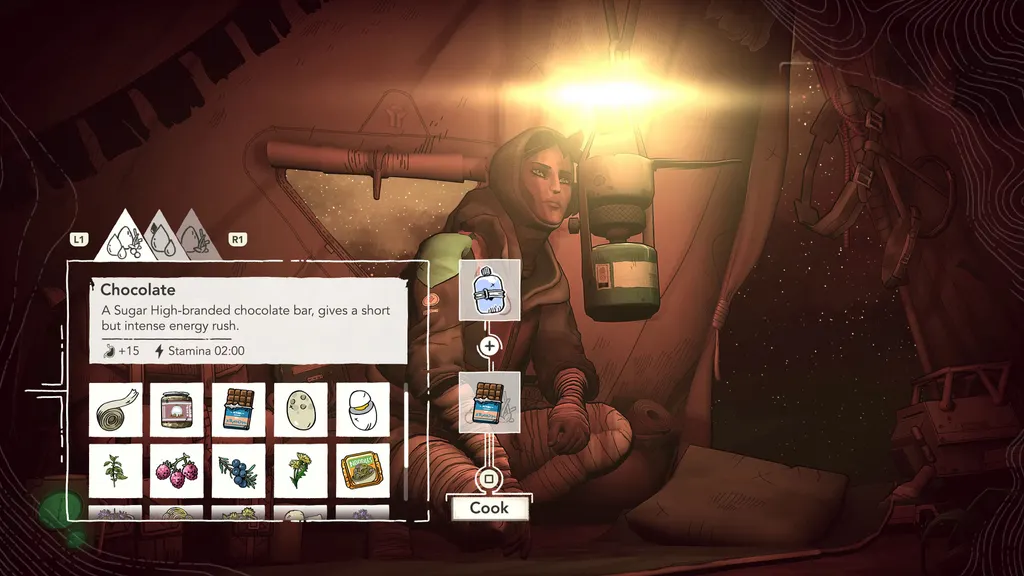
CAIRN doesn’t rely solely on its climbing mechanics; it throws in a collection of survival metrics to monitor and maintain. Hunger and thirst are obviously refilled by eating and drinking, while the temperature stat requires warmer foodstuffs to keep Aava warm. There’s enough here to engage the player without overwhelming and distracting from the core climbing gameplay, partly due to the fact that any crafting is siloed to the bivouac before Aava rests after a long day of climbing. The bivouac is Aava’s home for the duration of her expedition, allowing the player to craft new pitons, tape up injured fingers, sleep, and cook meals. You can, of course, just eat whatever you find lying around the environment (such as vegetables, herbs, and abandoned snacks) but cooking those scraps together can craft heartier meals that sustain Aava for longer, and provide buffs to her speed, grip strength, and resilience to boot. I found these meals indispensable by the time I reached the icy peaks of Mount Kami. It didn’t just make things easier; it made them manageable.
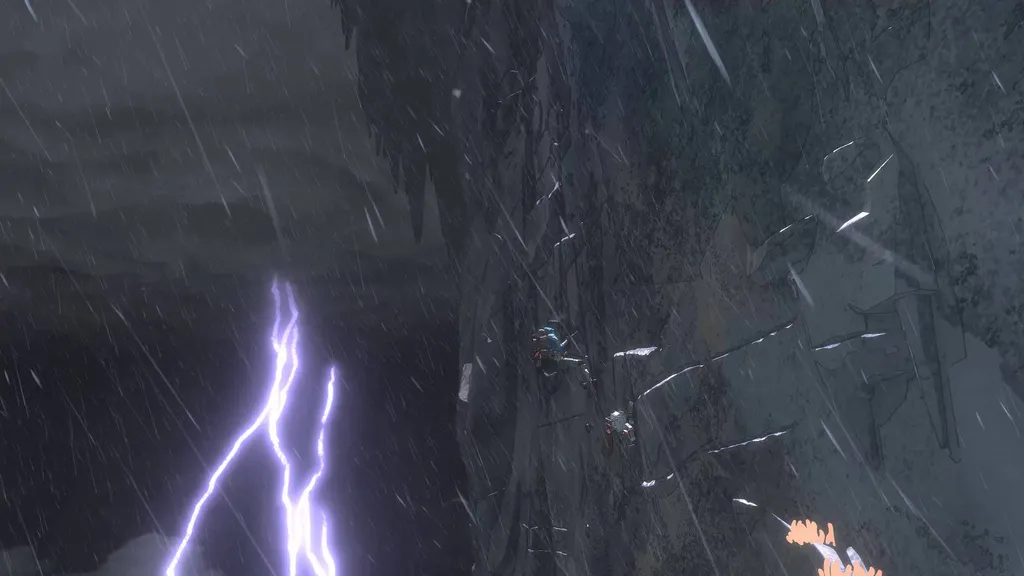
It’s not just Aava you’ll need to keep an eye on; the weather plays a huge role in how you’ll select routes and use consumables. Nightfall and fog reduce your visibility, rain makes surfaces slippery, and high-speed winds can fling Aava from the rockface if she’s not in a stable position. Deploying your chalk bag, switching on your portable lamp, or munching on a hot snack becomes all the more important when conditions take a turn for the worse. I’m not sure CAIRN would have survived solely on the back of its climbing mechanics, so thankfully the survival game was there to engage me when the climbing frustrated.
Verdict
The climbing might be awkward, but there’s still so much to love in CAIRN besides. It felt like a true achievement to reach the summit of Mount Kami; not in spite of the janky controls but because of the stunning environments, satisfying survival-lite mechanics, and affecting story. Despite its shortcomings, I’m embarking on my first “Free Solo” run tomorrow. Wish me luck.

